

Knee Arthroscopy

  • Home
  • Knee Arthroscopy

Knee Arthroscopy Simulation Course


Course Image
team image

Dr. Akash Kalaskar

Dr. Akash Kalaskar is an Orthopaedic Surgeon specializing in arthroscopic surgery of the shoulder and knee, with expertise in minimally invasive procedures for sports injuries and joint disorders. His clinical practice focuses on advanced arthroscopic techniques and comprehensive management of musculoskeletal conditions.

Read More
team image

Dr Rudra prasad

Dr. Rudra Prasad is a senior Orthopaedic Surgeon with extensive experience in the diagnosis and management of musculoskeletal disorders. He has developed strong expertise in arthroscopy, sports injury management, joint disorders, and trauma care. With decades of clinical experience, he has successfully managed a wide range of orthopaedic conditions involving the knee, shoulder, and other joints.

Read More
Course Overview

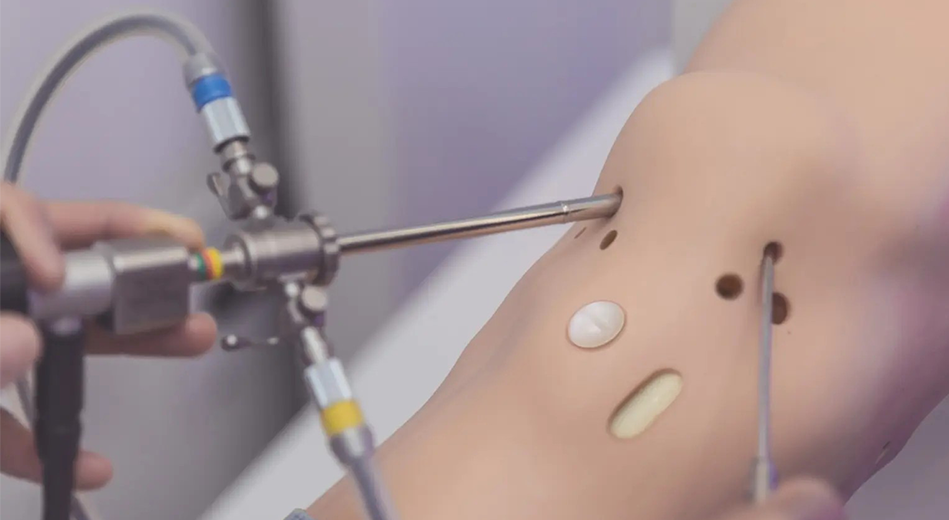
The Knee Arthroscopy Simulation Course is a focused, competency-based training program using the Knee simulator to prepare orthopaedic trainees for diagnostic and therapeutic knee arthroscopy. This high-fidelity mixed-reality simulator combines real surgical instruments with virtual anatomical cases, allowing participants to practice scope navigation, instrument handling, lesion identification, and therapeutic interventions in a risk-free environment.

Through progressive cases that span basic diagnostic tasks to more complex therapeutic scenarios such as meniscus management and loose body removal, learners refine technical skills, improve procedural fluency, and receive objective feedback through performance metrics. The curriculum emphasizes deliberate practice, error reduction, and proficiency benchmarks to accelerate the transition from simulation to clinical practice. This course is ideal for residents, fellows, and surgeons committed to enhancing arthroscopic skill and patient safety.

Learning Objectives
  • Understand arthroscopic knee anatomy and indications for diagnostic and therapeutic procedures
  • Develop camera navigation, triangulation, and psychomotor control skills
  • Identify intra-articular structures and common knee pathologies arthroscopically
  • Perform safe diagnostic evaluation and basic therapeutic tasks
  • Use simulator feedback to improve technical performance
Learning Methodology
  • High-fidelity mixed-reality simulation using VR anatomy with real instruments
  • Stepwise progression from basic visualization to advanced procedural tasks
  • Deliberate, repetitive practice with guided diagnostic cases
  • Objective performance metrics with video review and structured feedback
  • Faculty-led debriefing and case-based learning with pre- and post-assessment
Learning Outcomes
  • Perform a complete diagnostic knee arthroscopy simulation
  • Demonstrate efficient camera control and bimanual handling
  • Accurately identify common knee pathologies
  • Complete basic therapeutic arthroscopic tasks on simulator
  • Use objective performance feedback for continued improvement
Eligibility Criteria
  • MBBS with MS/DNB in Orthopaedics or equivalent
  • Orthopaedic residents (PGY-2+), fellows, or practicing surgeons
  • Basic exposure to arthroscopy recommended
  • Valid medical registration
Course Modules
Module 1: Arthroscopic Fundamentals & Simulator Orientation
  • Arthroscopy equipment setup and ergonomics
  • Camera handling and horizon control
  • Simulator familiarization and instrument calibration
  • Safe portal awareness
Module 2: Diagnostic Arthroscopy Techniques
  • Systematic joint inspection sequence
  • Identification of normal intra-articular anatomy
  • Probe handling and palpation techniques
  • Complete diagnostic checklist execution
Module 3: Camera Navigation & Bimanual Skills
  • Smooth camera navigation and spatial orientation
  • Hand–eye coordination development
  • Bimanual instrument control
  • Triangulation techniques
Module 4: Pathology Identification & Reporting
  • Recognition of common arthroscopic pathologies
  • Differentiation between normal and abnormal findings
  • Arthroscopic documentation and reporting
  • Verbal interpretation of findings
Module 5: Therapeutic Arthroscopy Tasks
  • Basic therapeutic instrument handling
  • Debridement and tissue resection techniques
  • Loose body management
  • Safe task execution principles
Module 6: Advanced Therapeutic Scenarios
  • Complex pathology-based simulations
  • Procedural sequencing and decision-making
  • Error recognition and correction
  • Complication avoidance strategies
Module 7: Objective Assessment & Performance Review
  • Objective skill metrics evaluation
  • Time, precision, and efficiency analysis
  • Faculty feedback and performance debriefing
  • Simulation readiness assessment
WhatsApp
