
Cardiac Ultrasound

  • Home
  • Cardiac Ultrasound

Cardiac Ultrasound Simulation Training


Course Image
Course Overview

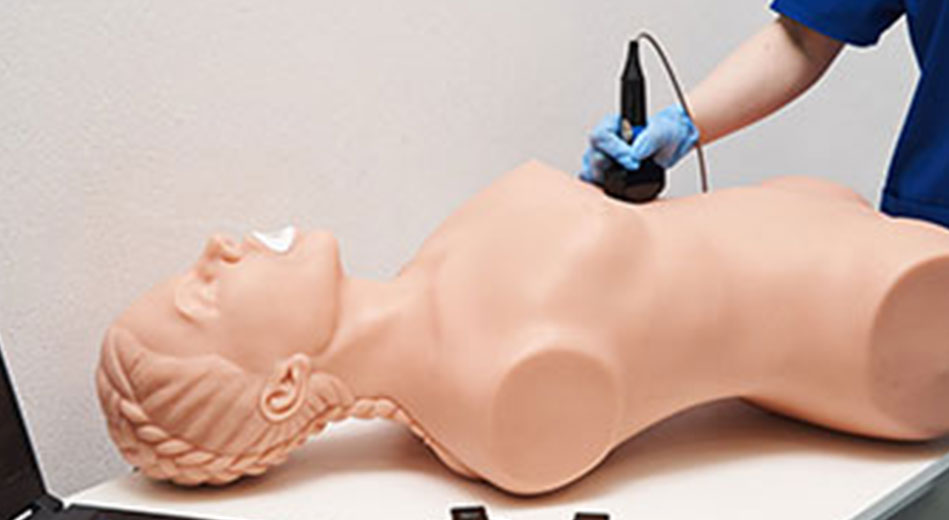
The Cardiac Ultrasound Simulation Training Program is designed to build strong foundational and clinical echocardiography skills in a structured, pressure-free environment. The course focuses on developing spatial orientation, image interpretation, and hemodynamic understanding before transitioning to real-world patient scanning.

Using a high-fidelity ultrasound simulator with real patient datasets, participants learn to translate probe movement into meaningful cardiac views, recognize normal and pathological findings, and integrate ultrasound data into clinical decision-making. Emphasis is placed on systematic image acquisition, Doppler application, and focused cardiac assessment in routine and acute care scenarios.

By mastering these skills through repetition and guided feedback, learners develop confidence, consistency, and clinical readiness- reducing dependence on trial-and-error learning in live settings.

Learning Objectives
  • Understand ultrasound physics and instrumentation relevant to cardiac imaging
  • Develop accurate probe positioning and transducer orientation skills
  • Acquire standard transthoracic echocardiographic views systematically
  • Apply Doppler principles for cardiac flow assessment
  • Perform essential cardiac measurements using simulation tools
  • Integrate focused cardiac ultrasound protocols into clinical scenarios
  • Interpret common cardiac pathologies using structured image analysis
Learning Methodology
  • High-fidelity cardiac ultrasound simulator–based training
  • Faculty-guided hands-on scanning sessions
  • Progressive skill modules (image acquisition → Doppler → quantification)
  • Real-time transducer tracking and 3D anatomy correlation
  • Case-based interpretation using real patient datasets
  • Objective performance metrics and session review
Learning Outcomes
  • Consistently obtain diagnostically adequate TTE images
  • Perform a complete basic cardiac ultrasound examination independently
  • Accurately document cardiac findings using standardized reports
  • Demonstrate improved image optimization and Doppler alignment
  • Confidently assist in or perform bedside cardiac ultrasound examinations
  • Transition safely to supervised clinical echocardiography practice
Eligibility Criteria
  • Anesthesiologists and anesthesia trainees
  • Intensivists and critical care physicians
  • Emergency medicine physicians
  • Cardiology trainees
  • Medical professionals beginning cardiac ultrasound practice
Course Modules
Module 1: Foundations of Cardiac Ultrasound
  • Ultrasound physics relevant to echocardiography
  • Image formation, resolution, and artifacts
  • Knobology and basic machine controls
  • Orientation and standard cardiac imaging planes
Module 2: Cardiac Anatomy & Probe Handling
  • 3D cardiac anatomy correlated with 2D echo views
  • Real-time transducer tracking and spatial orientation
  • Standard TTE probe positions and movements
  • Chamber identification and valve anatomy
  • Image optimization in real-time simulation
Module 3: Standard Transthoracic Echocardiography Views
  • Parasternal long-axis and short-axis views
  • Apical views (4CH, 2CH, 3CH)
  • Subcostal and suprasternal views
  • Real-time B-Mode and M-Mode imaging
  • Case-based interpretation (Normal & Pathology sets)
Module 4: Doppler Echocardiography
  • Color Doppler principles and optimization
  • Pulsed Wave Doppler (PWD)
  • Continuous Wave Doppler (CWD)
  • Angle correction and flow assessment
  • Velocity and pressure gradient concepts
Module 5: Cardiac Measurements & Functional Assessment
  • Chamber size and wall thickness measurements
  • LV systolic function assessment
  • RV systolic function assessment
  • Diastolic function basics
  • Volume and distance measurements
  • Ejection fraction estimation (visual & Simpson’s method)
Module 6: Clinical Integration & Reporting
  • Case-based clinical scenarios
  • Focused TTE protocols
  • Rapid peri-arrest and shock assessment
  • Measurement documentation and image capture
  • Structured echocardiography reporting
  • Session recording, review, and performance feedback

Quick Contact

WhatsApp