
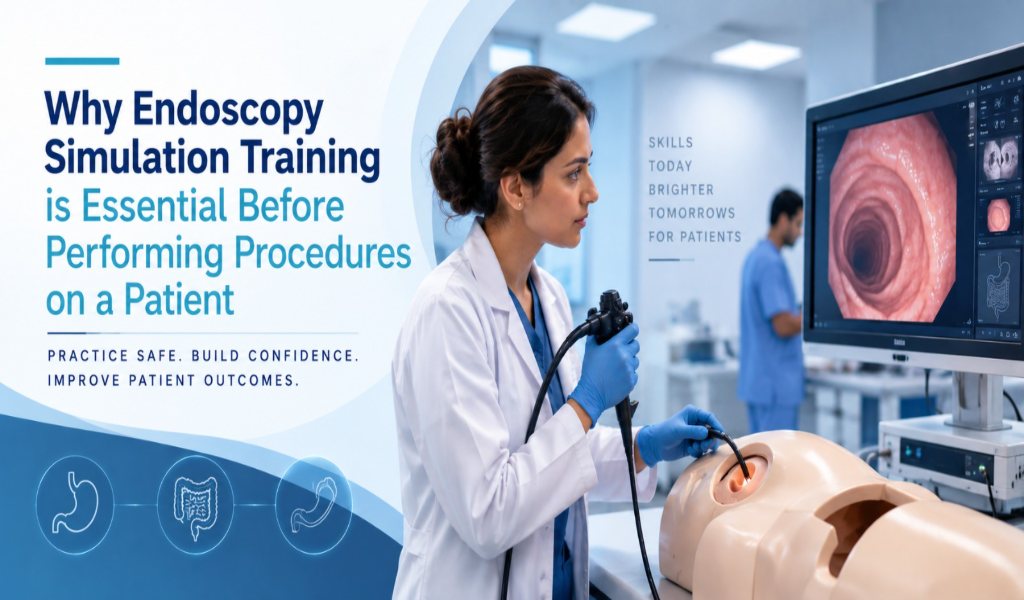
Why Endoscopy Simulation Training is Essential Before Performing Procedures on a Patient
An endoscopy is a procedure that allows a doctor to observe inside the body without performing major surgery. It is also called gastroscopy
Introduction
Endoscopy involves guiding a long, flexible tube with a camera through the gastrointestinal tract. It requires delicate hand eye coordination. Instead of practicing those tricky movements on humans, doctors use simulation.
Endoscopy simulation training provides a controlled environment in which learners can practice the fundamental techniques before progressing to clinical procedures. Simulation allows repeated practice, correction of mistake and feedback without exposing patient to risk.
What is Endoscopic Simulation
Endoscopy simulation training uses models, mechanical trainers, virtual reality (VR) systems, or other simulated settings to help doctors practice endoscopic procedures. Depending on the type of simulator, learners can practise skills such as moving and controlling the endoscope, navigating through different areas, controlling the tip, and improving their view of the procedure.
The main goal of simulation training is not to replace real clinical experience allows beginners and developing doctors to practise. It allows beginners and developing doctors to practise decision-making and handling the endoscope repeatedly in a safe environment without putting patients at risk. The American Society for Gastrointestinal Endoscopy (ASGE) recommends clear learning goals, hands-on practice, feedback, and competency-based assessment as important parts of endoscopy training.
Why is Simulation-Based Training Important Before Patient Procedures
Patients should not be practise as models. A clinical procedure involves individual anatomy, medical history, sedation needs, and procedures always carry a risk of complications. Because of this trainee need opportunities to develop basic procedural skills before they are expected to perform independently.
Simulation offers a lower-risk for early learning. Trainees can practice, learn from their mistakes, get instant feedback, and try again without putting anyone at risk. Research shows that doctors who train on endoscopy simulators build better hands-on skills, perform better in real clinics, and deliver safer patient care.
The Role of Hands-On Endoscopy Training in Building Confidence
Confidence in performing medical procedures should be proven skills, not just being familiar with the procedure. Hands-on endoscopy training allows doctors to become familiar with the equipment and practise the necessary movements before performing similar procedures on real patients. Using a simulator helps learners understand common difficulties and learn how to solve problems. Feedback from an instructor helps them identify their mistakes and learn how to improve. This combination of practice and feedback makes the training more effective and organized. The goal is not simply to increase confidence, but to build confidence that is supported by observable skills and appropriate supervision.
Can Simulation Help Reduce Procedural Errors and Improve Patient Safety
Simulation cannot prevent every complication or guarantee that a procedure will be completely error-free. However, it gives learners a safe environment to practise technical skills and deal with common difficulties without putting patients at risk. This is especially helpful when learners are developing their basic skills.
Simulation also helps trainers teach important safety practices before trainees start performing procedures on patients. Patient safety should always be the top priority during training, and supervisors should step in whenever a trainee is unable to continue the procedure safely.
Who Can Benefit From Endoscopy Simulation Training
Simulation can be useful for different healthcare professionals involved in endoscopy training, depending on their experience and training needs. It can be helpful for:
- 1. Doctors who are starting to learn diagnostic GI endoscopy.
- 2. Trainees who are moving from basic to more advanced endoscopic procedures.
- 3. Endoscopists learning to use new equipment, techniques, or methods.
- 4. Doctors returning to endoscopy after a long break from practice.
- 5. Experienced doctors who want to practise specific skills or learn new technologies.
- 6. Endoscopy trainers who need a safe and consistent environment for teaching and assessing learners.
Conclusion
Endoscopy simulation training helps doctors learn and practise important skills in a safe environment before performing procedures on real patients. It gives them a chance to practise, make mistakes, receive feedback, and improve their skills without putting patients at risk.
Simulation does not replace real patient experience, but it helps doctors build a strong foundation. By combining simulation, hands-on training, and proper supervision, doctors can become more skilled, confident, and better prepared to provide safe care to patients
