
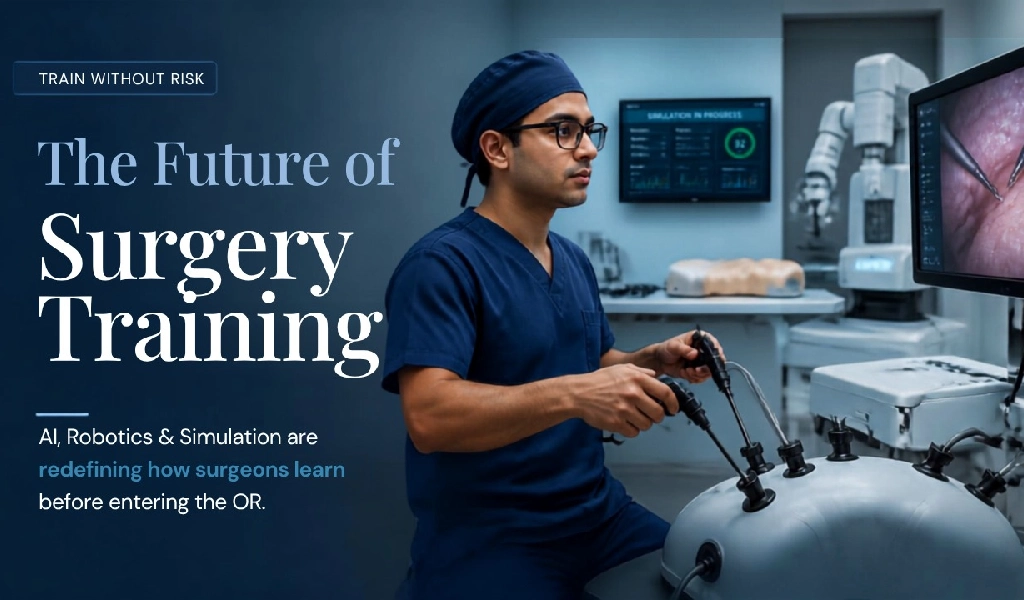
Simulation Training for Surgeons: How AI, Robotics, and Next-Generation Simulation Are Shaping the Future of Surgery
The future of surgery is being shaped by technology, precision, and continuous learning. As healthcare evolves, surgeons are expected to master advanced techniques, adapt to emerging technologies, and deliver safer, more effective patient care. Traditional training methods alone are no longer enough to prepare surgeons for the complexities of modern surgical practice.
Today, simulation training for surgeons, robotic surgery training, and comprehensive surgical skills training have become essential to surgical education. By combining artificial intelligence (AI), robotics, and high-fidelity simulation, healthcare professionals can develop technical expertise, improve clinical decision-making, and gain confidence before performing procedures on patients.
Why Modern Surgical Training Matters
Surgery has advanced significantly over the past decade. From minimally invasive procedures and robotic-assisted surgery to AI-powered technologies, the operating room is becoming increasingly sophisticated. Along with these advancements comes the need for structured training that prioritizes patient safety and clinical excellence.
Modern surgeons are expected to do more than perform procedures. They must interpret technology, collaborate effectively with multidisciplinary teams, and respond confidently to complex surgical situations. This is where structured surgical skills training plays a vital role.
Continuous learning helps surgeons:
- 1. Improve technical precision
- 2. Strengthen clinical decision-making
- 3. Adapt to evolving surgical technologies
- 4. Reduce procedural errors
- 5. Deliver safer patient outcomes
The Growing Role of AI in Surgical Education
Artificial intelligence is transforming how surgeons learn and refine their skills. Instead of relying solely on traditional assessments, AI-powered training platforms provide objective feedback based on performance.
AI can help:
- 1. Analyze instrument handling and movement
- 2. Measure accuracy and efficiency during procedures
- 3. Identify technical errors
- 4. Track learning progress over time
- 5. Provide personalized feedback for continuous improvement
These insights enable surgeons to improve their performance through measurable outcomes, making training more effective and competency-based.
Why Simulation Training for Surgeons is the New Standard
One of the most significant developments in surgical education is simulation training for surgeons.
Simulation-based learning allows healthcare professionals to practice procedures repeatedly in a safe, controlled environment before performing them in the operating room. This reduces risk while helping surgeons build confidence and technical proficiency.
Research has consistently shown that simulation-based education improves procedural performance and enhances patient safety, making it an integral part of modern surgical training.
Key benefits of simulation training for surgeons include:
- 1. Safe practice without patient risk
- 2. Improved hand-eye coordination
- 3. Better procedural accuracy
- 4. Enhanced confidence before live surgery
- 5. Stronger crisis management and teamwork skills
- 6. Greater consistency in surgical performance
High-fidelity simulation also recreates real clinical scenarios, allowing participants to experience challenges they may encounter in everyday surgical practice.
Robotic Surgery Training: Preparing Surgeons for the Next Generation of Care
Robotic-assisted surgery is becoming increasingly common across specialties such as urology, gynecology, gastrointestinal surgery, oncology, and cardiothoracic surgery. While robotic systems improve precision and visualization, they also require specialized training.
This is why robotic surgery training has become an essential part of surgical education.
Effective robotic training focuses on:
- 1. Console operation
- 2. Instrument control
- 3. Camera navigation
- 4. Ergonomic techniques
- 5. Precision and dexterity
- 6. Workflow coordination
- 7. Team communication during robotic procedures
Simulation-based robotic training allows surgeons to develop these skills through repeated practice before performing procedures in real clinical settings.
Building Surgical Excellence Through Hands-On Surgical Skills Training
Practical experience remains the foundation of surgical competence. While theoretical knowledge is important, confidence is built through repeated practice under expert guidance.
Comprehensive surgical skills training includes:
- 1. Suturing and knot tying
- 2. Laparoscopic skills
- 3. Tissue handling techniques
- 4. Endoscopic procedures
- 5. Microsurgical techniques
- 6. Emergency surgical scenarios
- 7. Instrument handling and coordination
Hands-on learning helps surgeons strengthen muscle memory, improve precision, and confidently apply their knowledge in the operating room.
How Next-Generation Simulation is Transforming Surgical Education
Simulation technology has evolved far beyond traditional training models. Today's simulation centres combine advanced technologies to create realistic clinical experiences.
Modern surgical simulation may include:
- 1. High-fidelity patient simulators
- 2. Virtual reality (VR)
- 3. Augmented reality (AR)
- 4. AI-powered performance assessment
- 5. Procedure-specific simulation modules
- 6. Team-based simulation exercises
These technologies provide opportunities to practice complex procedures, manage complications, and improve decision-making in a risk-free environment.
Why Choose Global Surgical Institute (GSI)?
As the demand for technology-enabled surgical education continues to grow, choosing the right learning environment becomes increasingly important.
The Global Surgical Institute (GSI) is dedicated to advancing surgical education through practical, simulation-based learning. Designed for surgeons, residents, and healthcare professionals, GSI offers programs that combine expert mentorship with modern training methodologies.
At GSI, participants benefit from:
- 1. High-fidelity simulation laboratories
- 2. Hands-on surgical training
- 3. Expert-led workshops
- 4. Case-based learning
- 5. Industry-relevant curriculum
- 6. Practical exposure before clinical application
Rather than focusing only on theory, GSI emphasizes experiential learning, helping participants build confidence, improve technical competency, and prepare for real-world surgical practice.
The Future of Surgical Training Starts Today
The future of surgery depends on continuous learning and the ability to adapt to rapidly advancing technologies. As AI, robotics, and simulation continue to reshape healthcare, surgeons must develop new competencies that extend beyond traditional training.
Whether through simulation training for surgeons, robotic surgery training, or comprehensive surgical skills training, investing in structured education helps healthcare professionals strengthen their expertise while improving patient safety and clinical outcomes.
Institutions like the Global Surgical Institute (GSI) are supporting this transformation by creating learning environments where innovation meets practical experience. By embracing technology-enabled education today, surgeons can confidently prepare for the future of surgical care.
