
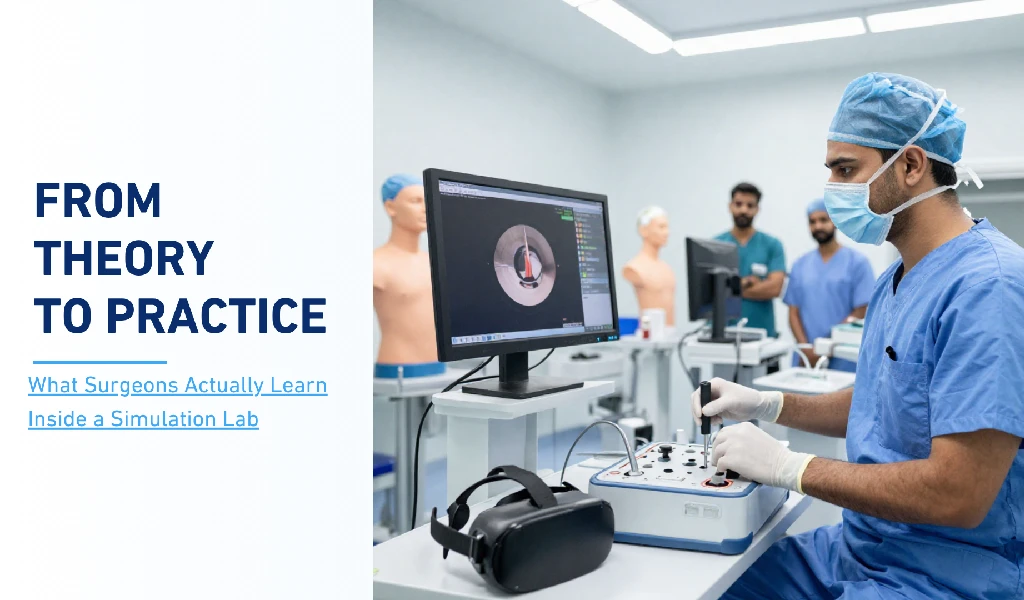
From Theory to Practice: What Surgeons Actually Learn Inside a Simulation Lab
Every surgeon begins their journey by mastering anatomy, understanding disease processes, and learning the principles that guide surgical decision-making. Yet, surgical excellence is not built through theory alone. It is developed through hands-on practice, repetition, experience, and the ability to make critical decisions under pressure.
At Global Surgical Institute (GSI), we engage with surgeons across specialties who share a common goal: translating knowledge into confident clinical performance. As surgical procedures become increasingly sophisticated and technology-driven, the need for structured, practical training environments has never been greater
This is where Surgical Simulation Training plays a transformative role.
A modern Surgical Simulation Lab provides surgeons with the opportunity to practice procedures, refine techniques, strengthen decision-making, and build confidence in a safe, controlled environment before applying those skills in real clinical settings.
But what exactly happens inside a simulation lab? What skills do surgeons develop? And why is a simulation course for surgeons becoming an essential part of modern surgical education?
What Is Surgical Simulation Training?
Surgical Simulation Training is a structured educational approach that allows surgeons to practice procedures, develop technical skills, improve clinical judgment, and enhance teamwork within a realistic yet risk-free learning environment.
Training may involve:
- 1. Procedure-specific task trainers
- 2. Anatomical models
- 3. Laparoscopic simulators
- 4. Robotic surgery simulators
- 5. Virtual Reality (VR) platforms
- 6. Cadaveric workshops
- 7. Augmented Reality (AR) learning systems
The goal is straightforward: provide surgeons with opportunities to learn, practice, and improve before performing procedures on patients.
As healthcare systems increasingly focus on quality outcomes and patient safety, simulation-based learning has become a critical component of surgical education worldwide.
Why Modern Surgical Education Requires More Than Observation
For decades, surgical training followed the traditional "see one, do one, teach one" approach. While observation remains valuable, the complexity of modern surgery demands more comprehensive preparation before entering the operating room.
Several factors have accelerated the adoption of simulation-based education:
- 1. Increasing procedural complexity
- 2. Growth of minimally invasive surgery
- 3. Rapid technological advancements
- 4. Greater focus on patient safety
- 5. Need for competency-based learning
- 6. Expectations for continuous professional development
Through its educational initiatives, Global Surgical Institute (GSI) has observed a growing demand for hands-on learning experiences that allow surgeons to safely develop procedural confidence while exploring new techniques and technologies.
A well-designed simulation course for surgeons bridges the gap between theoretical understanding and practical application, ensuring participants gain meaningful experience before clinical implementation.
What Surgeons Actually Learn Inside a Surgical Simulation Lab
While many assume simulation training focuses solely on procedural practice, a comprehensive Surgical Simulation Lab develops a wide range of technical and non-technical competencies that are essential for modern surgical practice.
1.Technical Surgical Skills and Procedural Mastery
The foundation of every simulation course for surgeons is technical skill development.
Participants learn and refine:
- 1. Instrument handling
- 2. Tissue manipulation
- 3. Suturing and knot tying
- 4. Dissection techniques
- 5. Hemostasis management
- 6. Procedural workflows
- 7. Surgical ergonomics
- 8. Specialty-specific operative techniques
One of the greatest advantages of simulation is the ability to practice repeatedly. Unlike real-world surgical settings, where learning opportunities may be limited by time and patient considerations, simulation allows surgeons to perform procedures multiple times until confidence and proficiency are achieved.
Many simulation-based workshops facilitated through GSI's educational programs are built around deliberate practice models, allowing participants to continuously improve through repetition, expert feedback, and guided learning.
2. Developing a Three-Dimensional Understanding of Anatomy
Anatomical knowledge forms the cornerstone of surgical practice. However, there is a significant difference between studying anatomy in textbooks and navigating it during a procedure.
Inside a Surgical Simulation Lab, surgeons gain practical exposure to:
- 1. Three-dimensional anatomical relationships
- 2. Surgical landmarks
- 3. Anatomical variations
- 4. Procedure-specific anatomy
- 5. Spatial orientation during surgery
This hands-on experience helps improve procedural planning and enhances intraoperative decision-making, particularly during complex interventions.
4. Robotic Surgery Training
Robotic-assisted surgery is increasingly becoming part of modern surgical practice. While robotic platforms offer significant advantages, they also require surgeons to develop new technical competencies.
Simulation-based robotic training helps participants gain familiarity with:
- 1. Console navigation
- 2. Instrument articulation
- 3. Advanced visualization systems
- 4. Workflow integration
- 5. Robotic procedural techniques
Recognizing the growing role of robotic surgery, Global Surgical Institute (GSI) continues to support educational initiatives that help surgeons adapt to emerging technologies while maintaining high standards of patient care.
5. Clinical Decision-Making Under Pressure
Surgery rarely follows a perfect script. Unexpected situations can arise at any stage of a procedure, requiring surgeons to make rapid, evidence-based decisions.
Simulation scenarios expose participants to challenges such as:
- 1. Intraoperative bleeding
- 2. Equipment malfunction
- 3. Anatomical anomalies
- 4. Surgical complications
- 5. Emergency situations
Through realistic training exercises, surgeons learn how to:
- 1. Assess situations quickly
- 2. Prioritize interventions
- 3. Adapt operative strategies
- 4. Remain composed under pressure
- 5. Make confident clinical decisions
These experiences help prepare surgeons for the realities of the operating room.
6. Communication, Leadership, and Teamwork
Successful surgery depends on more than technical expertise. Modern operating rooms function as highly coordinated teams involving surgeons, anesthesiologists, nurses, technicians, and support staff.
Many Surgical Simulation Training programs incorporate team-based exercises designed to strengthen:
- 1. Communication skills
- 2. Leadership capabilities
- 3. Team coordination
- 4. Situational awareness
- 5. Crisis management
By recreating real operating room dynamics, simulation helps healthcare professionals work together more effectively and improve patient outcomes.
7. Learning Through Errors Without Risking Patient Safety
One of the most valuable aspects of simulation-based education is the freedom to learn from mistakes.
In a Surgical Simulation Lab, participants can:
- 1. Identify errors
- 2. Understand their causes
- 3. Receive expert guidance
- 4. Correct techniques
- 5. Refine future performance
This environment encourages continuous improvement while eliminating risk to patients. The ability to fail, learn, and improve in a safe setting is one of the reasons simulation has become such a powerful educational tool.
Conclusion
The journey from theory to practice is one of the most important transitions in a surgeon's professional development. While knowledge provides the foundation, true surgical excellence is built through experience, repetition, reflection, and continuous learning.
A modern Surgical Simulation Lab serves as a bridge between classroom learning and clinical performance, enabling surgeons to develop technical expertise, improve decision-making, strengthen teamwork, and build confidence before entering the operating room.
As healthcare continues to evolve, Surgical Simulation Training will remain an essential component of surgeon education and professional development.
At Global Surgical Institute (GSI), we believe that the future of surgical education lies in combining knowledge with hands-on experience. Through simulation-based learning, expert mentorship, and continuous innovation, GSI remains committed to supporting surgeons in their pursuit of clinical excellence and better patient outcomes.
Because the safest place to learn, improve, and innovate is before the first incision is ever made.
