
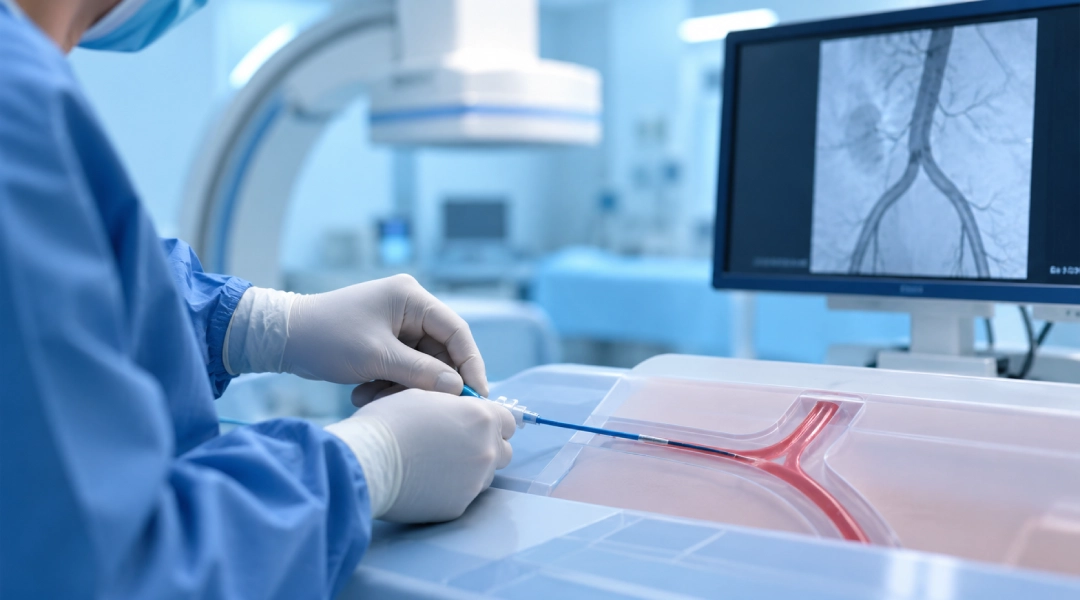
Endovascular Simulation Training: Rehearsing High-Stakes Catheter Skills Safely
Endovascular procedures compress enormous consequence into millimetre-level catheter and wire movements guided by fluoroscopy, radiation exposure, and contrast timing.
For clinicians pursuing endovascular simulation training, the gap between theoretical knowledge and confident hands-on execution is exactly what structured, repeatable practice is designed to close.
The Traditional Learning Curve
Interventional cardiologists, radiologists and vascular specialists typically build this judgment case by case under a mentor's supervision, but access to less common anatomy or complication scenarios is unpredictable and cannot always be planned around a trainee's schedule.
This is precisely where dedicated endovascular simulation programs add value: they compress years of scattered exposure into a structured, mentor-guided experience. Instead of hoping the right case appears on the right day, clinicians can rehearse the exact scenario they need to master, as many times as it takes.
The consequence of skipping this step isn't abstract. A technique that hasn't been rehearsed under guidance tends to show up as hesitation, longer operative time, or an over-reliance on a senior colleague stepping in — none of which build the independent confidence a clinician is ultimately working toward.
What the Training Covers
A well-designed program builds skill in layers, moving from fundamentals to complex, case-based scenarios rather than throwing a trainee into the deep end. Typical components include:
- 1. Vascular access and the fundamentals of sheath placement.
- 2. Wire and catheter navigation across aortic, coronary and peripheral territories
- 3. Simulated complication management, including dissection and perforation
- 4. Structured pathways covering ASD/PFO closure, transseptal puncture and embolization procedures
- 5. Radiation-safe practice repetitions without patient risk
How the Program Is Structured
Training is delivered in small groups so each participant gets meaningful hands-on time rather than watching from the back of a room. Sessions move progressively from guided demonstration to independent, faculty-supervised practice, with performance discussed and corrected in real time rather than left to self-assessment. This structure is deliberate: skills that are corrected early are far less likely to become ingrained bad habits later in independent practice.
Why Hands-On Simulation Training Works
Unlike live cases, simulation and cadaveric-based training allow a trainee to pause, repeat, and correct technique in real time without patient risk. Structured feedback from experienced faculty accelerates the transition from "familiar with the steps" to "confident under pressure" - a distinction that matters enormously the first time a real case doesn't go exactly to plan.
Programs at Global Surgical Institute in Bangalore combine this hands-on repetition with objective performance assessment, so progress is measurable rather than assumed. Participants leave with a clearer, more honest picture of what they've mastered and what still needs more repetition — something a single live case can rarely provide.
Who Should Enroll
This training is designed for interventional cardiologists, vascular surgeons and interventional radiologists building endovascular case volume outside the catheterization lab. Whether the goal is building a new skill from scratch or refining technique that's already in regular use, the structured format adapts to different starting points, and faculty tailor feedback accordingly rather than running a one-size-fits-all curriculum.
Frequently Asked Questions
Do I need prior experience to join this endovascular simulation training program?
Most programs welcome a range of experience levels, from those building a skill for the first time to practising clinicians looking to refine technique. Faculty adjust pacing and case complexity based on where each participant starts.
Is certification provided after completing the training?
Yes. Participants who complete the program receive a certificate of completion, which can support credentialing, CME requirements, or simply document structured hands-on training undertaken outside the operating room.
How is this different from attending a conference workshop?
Conference workshops are typically short, high-volume sessions with limited individual hands-on time. This program is built around small-group, repeated practice with direct faculty supervision, so the focus is on individual skill development rather than a one-time demonstration.
Take the Next Step
Confidence in the operating room is built long before the first incision. Structured, hands-on training in endovascular simulation training gives clinicians a safe, repeatable path to that confidence, backed by objective feedback instead of guesswork.
Ready to build this skill hands-on? Explore the Endovascular Simulation Training program at Global Surgical Institute, Bangalore, and enquire to reserve a seat.
