
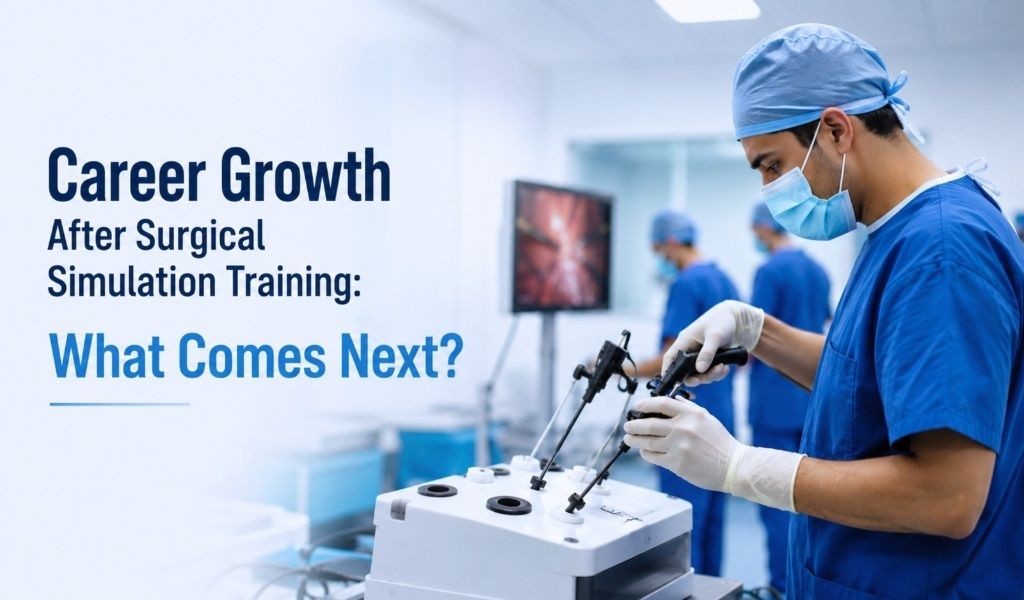
Career Growth After Surgical Simulation Training: What Comes Next?
A modern simulation training program is no longer just an educational advantage for surgeons. It has become an essential part of career growth in today’s rapidly evolving healthcare landscape.
From minimally invasive procedures to robotic-assisted surgery, healthcare institutions increasingly seek surgeons who possess not only theoretical knowledge but also strong practical expertise, technical precision, and procedural confidence.
This is where simulation-based surgical education is transforming the future of medical training.
Through structured Hands-On Surgical Training, surgeons can repeatedly practice complex procedures in a safe and controlled environment before entering real operating rooms. This approach strengthens technical skills, improves decision-making, enhances patient safety, and helps surgeons adapt to rapidly advancing surgical technologies.
At Global Surgical Institute (GSI), we believe simulation-based surgical education plays a critical role in shaping confident, future-ready surgeons through practical learning experiences designed for modern healthcare environments.
But after completing a simulation course for surgeons, one important question naturally follows:
What comes next?
For many surgeons, simulation training becomes more than a short-term educational experience. It often becomes the foundation for specialization, career advancement, leadership opportunities, and long-term professional growth.
Why Simulation Training Matters in Modern Surgery
Traditional surgical education relied heavily on observation-based learning. Surgeons spent years assisting senior professionals before gradually performing procedures independently.
While that system shaped generations of skilled surgeons, modern healthcare now demands:
- 1. Faster learning curves
- 2. Better technical accuracy
- 3. Improved patient safety
- 4. Familiarity with advanced surgical technologies
- 5. Competency-based training
A structured simulation training program helps bridge the gap between theoretical learning and practical execution.
Instead of depending entirely on live patient exposure, surgeons can now practice repeatedly using:
- 1. Laparoscopic simulators
- 2. Cadaveric workshops
- 3. Virtual reality systems
- 4. Robotic surgery simulators
- 5. Endoscopic training modules
This allows surgeons to refine their skills without compromising patient safety while building confidence before entering high-pressure surgical environments.
Immediate Benefits After Completing a Simulation Course for Surgeons
One of the biggest advantages of a simulation course for surgeons is the immediate improvement many participants notice in their clinical performance.
Increased Confidence
Simulation training reduces hesitation by allowing repeated procedural practice in a controlled setting.
Surgeons become more comfortable with:
- 1. Surgical instruments
- 2. Procedural sequencing
- 3. Minimally invasive techniques
- 4. Crisis management
- 5. Advanced surgical equipment
As confidence improves, surgeons often experience:
- 1. Better decision-making
- 2. Improved teamwork
- 3. Reduced stress during procedures
- 4. Greater consistency in surgical performance
Improved Technical Precision
One of the most valuable outcomes of Hands-On Surgical Training is technical refinement.
Simulation environments help surgeons improve:
- 1. Hand-eye coordination
- 2. Tissue handling
- 3. Suturing skills
- 4. Instrument navigation
- 5. Depth perception
- 6. Procedural accuracy
Repeated practice gradually builds muscle memory, smoother instrument control, and stronger procedural discipline.
These improvements become highly noticeable in real clinical practice.
Stronger Professional Credibility
Healthcare institutions increasingly value surgeons who actively pursue additional surgical skills training.
Completing a recognized simulation training program demonstrates:
- 1. Commitment to continuous learning
- 2. Technical preparedness
- 3. Adaptability to modern healthcare systems
- 4. Interest in advanced surgical techniques
This can strengthen applications for:
- 1. Fellowships
- 2. Consultant positions
- 3. Academic programs
- 4. International observerships
- 5. Advanced surgical centers
How Hands-On Surgical Training Supports Career Growth
Many surgeons initially enroll in simulation programs to improve procedural skills. However, the long-term benefits often extend much further.
Pathway Into Minimally Invasive Surgery
Minimally invasive procedures are becoming the preferred approach across many surgical specialties.
Compared to open surgery, these procedures often offer:
- 1. Smaller incisions
- 2. Faster recovery
- 3. Reduced pain
- 4. Shorter hospital stays
- 5. Better cosmetic outcomes
However, they also require advanced coordination and precision.
Through simulation-based learning, surgeons gain the confidence needed to transition into:
- 1. Advanced laparoscopy
- 2. Endoscopic procedures
- 3. Arthroscopic surgery
- 4. Robotic-assisted surgery
As healthcare systems increasingly adopt minimally invasive approaches, surgeons with advanced practical training remain in high demand
Greater Fellowship and Specialization Opportunities
Competitive fellowship programs often prefer candidates with strong technical foundations.
Simulation-trained surgeons are frequently viewed as:
- 1. Better prepared
- 2. Faster learners
- 3. More adaptable
- 4. Technically refined
This becomes especially valuable in specialties such as:
- 1. Surgical oncology
- 2. Neurosurgery
- 3. Orthopedics
- 4. Urology
- 5. Gastrointestinal surgery
- 6. Plastic surgery
Prior exposure to simulation-based surgical education often helps surgeons adapt more quickly during advanced specialty training.
How Simulation Training Prepares Surgeons for Robotic Surgery
Robotic surgery is rapidly transforming modern healthcare.
However, robotic systems require surgeons to develop:
- 1. Advanced instrument coordination
- 2. Console navigation skills
- 3. Visual-spatial awareness
- 4. Precision-based movements
Simulation-based learning acts as an ideal introduction to robotic surgery by allowing surgeons to practice safely before performing live procedures.
As robotic-assisted procedures continue expanding globally, surgeons with simulation exposure are likely to remain highly competitive in the future healthcare landscape.
Leadership and Academic Opportunities
Simulation training also strengthens non-technical skills that are essential in surgery.
Through scenario-based learning, surgeons improve:
- 1. Communication
- 2. Crisis management
- 3. Team coordination
- 4. Decision-making under pressure
These qualities become valuable for surgeons pursuing:
- 1. Department leadership
- 2. Academic administration
- 3. Surgical mentorship roles
- 4. Residency teaching programs
Many simulation-trained surgeons eventually move into teaching, workshop facilitation, and medical education roles as simulation centers continue growing worldwide.
The Human Side of Simulation-Based Learning
Beyond technical expertise and career advancement, simulation training provides something equally important: preparedness.
Surgery is one of the most demanding professions in healthcare. Every procedure requires precision, focus, and confidence.
Simulation-based learning creates a safe environment where surgeons can:
- 1. Practice repeatedly
- 2. Learn from mistakes
- 3. Improve gradually
- 4. Build confidence without fear
- 5. Develop professional resilience
For many surgeons, this experience changes not only how they perform procedures but also how they approach challenges throughout their careers.
The Future of Surgical Careers Is Skill-Driven
Healthcare is increasingly moving toward competency-based practice.
Hospitals and healthcare institutions now prioritize:
- 1. Technical precision
- 2. Practical surgical expertise
- 3. Simulation-based assessments
- 4. Procedural efficiency
- 5. Continuous upskilling
At Global Surgical Institute (GSI), our focus is on helping surgeons strengthen practical expertise through advanced simulation-based learning that aligns with the evolving demands of modern healthcare.
The shift is clear:
From experience-based progression to competency-based progression.
And simulation training is playing a major role in that transformation.
Final Thoughts
A high-quality simulation course for surgeons is far more than an educational experience. It can become the foundation for long-term surgical career growth.
From improving confidence and technical precision to opening doors for fellowships, minimally invasive surgery, research opportunities, teaching roles, and leadership positions, simulation-based education continues shaping the future of healthcare.
Most importantly, Hands-On Surgical Training prepares surgeons for the realities of modern surgical practice where adaptability, patient safety, continuous learning, and practical expertise matter more than ever before.
Because in today’s rapidly advancing healthcare landscape, the surgeons who continue learning are often the ones who grow the fastest.
